Assessment and PR outlook
Every number shows its working. And its history.
Pathway's assessments come from a rules engine, not from AI. Each rule is checked against its official page and dated, the same answers always give the same result, and every result says what it rests on and when it changed.
Why rules, not AI
An eligibility assessment answers questions with fixed answers. Is the client under 45? How many points for a master's degree? Is the occupation on the list for this visa? Does the salary meet the threshold? Each has one right answer today. That's a job for rules, not for a model that predicts likely words. An agent has to be able to explain a result and stand behind it, so Pathway's assessment never uses AI. Pathway AI can talk about an assessment; it never produces one.
What it assesses
The engine assesses the 189, 190, 491, 191, 482 (Core Skills and Specialist Skills), 186 (Temporary Residence Transition and Direct Entry), 494 and 485. For each visa: likely, possible, needs answers, or not eligible, with every check shown as met, not met or unknown. A missing answer is never a failure: it becomes "needs answers", so you know what to ask. For any other visa, the file says plainly that the engine doesn't assess it, and the checklists and steps still work.
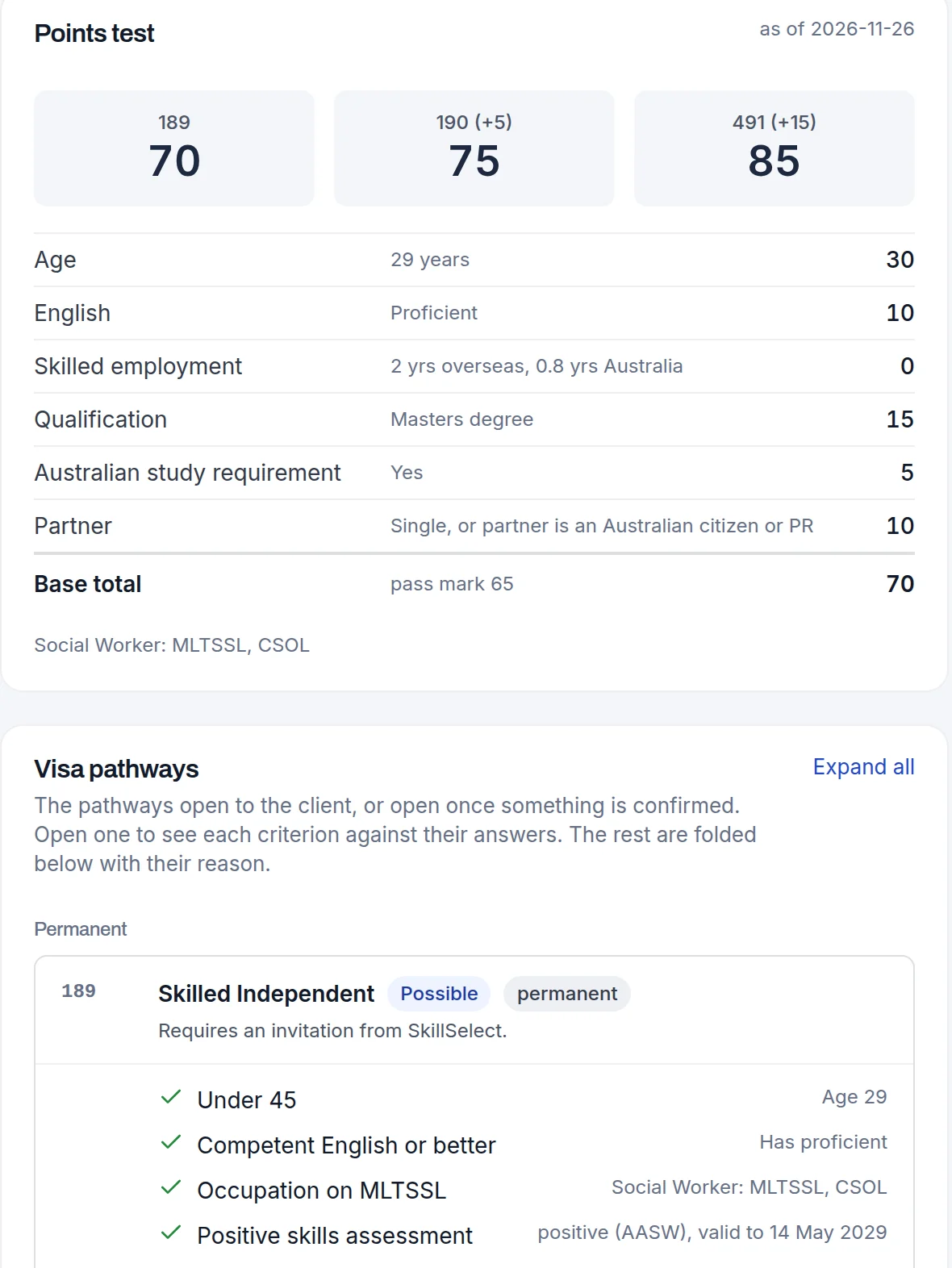 The points test, factor by factor, and the 189's criteria each checked against the client's answers.
The PR outlook
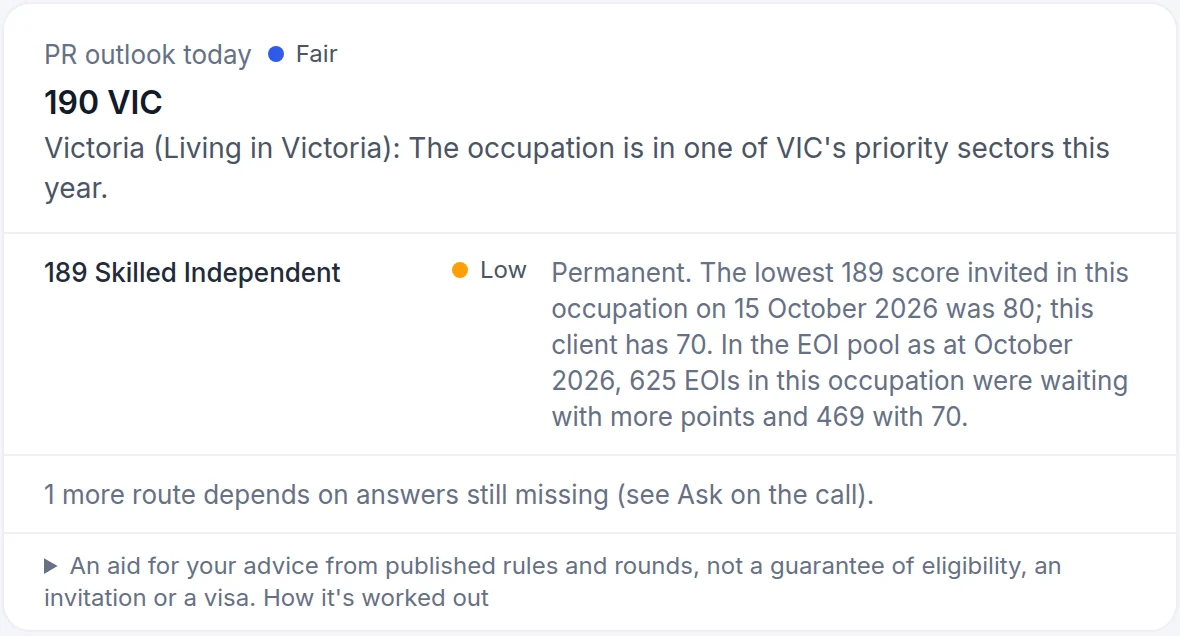
One level for the person, with the best route and the reason, and every other route worth knowing about:
| Situation | Outlook |
|---|---|
| Already invited, and meeting every check | Strong |
| Meets every check for a permanent visa applied for directly (191, 186) | Strong |
| 189: points above the occupation's last cut-off | Good |
| 189: points equal to the cut-off | Fair or good, depending on the tie-break date |
| 189: below the cut-off, or the occupation wasn't invited | Low |
| 190 or 491: the best open state the client fits | That state's chance |
| 494 with every check met | Good (an employer still has to nominate) |
| 482 with every check met | Fair (two years with the sponsor can open the 186) |
| Answers missing | Unclear |
| Nothing open | None |
It's called an outlook, never a promise: invitations go to the highest-ranked EOIs at the time. The levels are rules; the counts in the EOI pool aren't turned into odds, because there's no data to calibrate them.
Where they stand in the queue
The last round says what score was invited. The EOI pool says how many people are queued ahead, which decides whether the next round reaches the client. Pathway shows both: the lowest score invited in the client's occupation in recent rounds, with the tie-break date, and how many EOIs claim more points, and the same, for the 189, 190 and 491, and for each state. The pool comes from the Department of Employment and Workplace Relations' monthly SkillSelect data: counts only, no personal data.
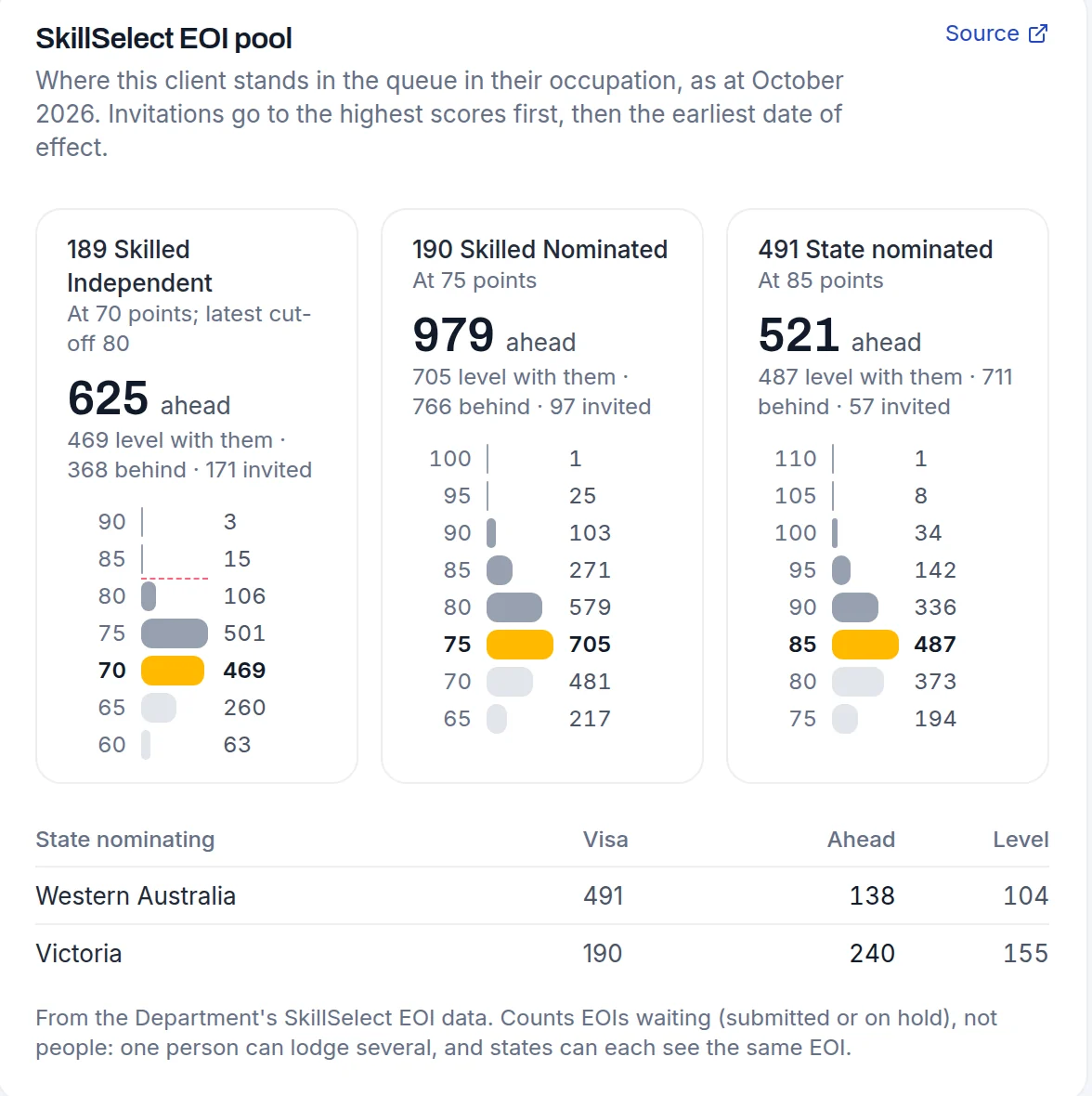 A client's place in the EOI pool: EOIs ahead and level for each visa, and for each state.
Before the first call
Every enquiry is labelled the moment it's assessed:
- Worth a consultation: the outlook is fair or better, any visa is likely or possible, or the skilled basics are all there (under 45, Competent English, an occupation on a skilled list).
- Nothing open today: one of those basics fails and the outlook is none or low.
- Can't tell yet: anything else.
Those three basics decide because points and a skills assessment can be worked on; age, English below Competent and an occupation off the lists mostly can't. The one-page brief adds the near misses, anything time-sensitive (a visa ending, a birthday that costs age points), ways to gain points with the effort each takes, the questions to ask on the call, and the claims to check against documents.
Basis and history
At the foot of every assessment:
- Basis: the day it was worked out, the version of the rules, how many rule values were checked against official pages and when, which round and which month of the EOI pool it used, and any official page that has changed and not yet been re-checked.
- History: a record each time the result materially changed (points, a visa's status, a state's chance, the outlook), with the cause: questionnaire submitted, answers edited, a new round, new rules, a new day, details applied from a document, a visa granted.
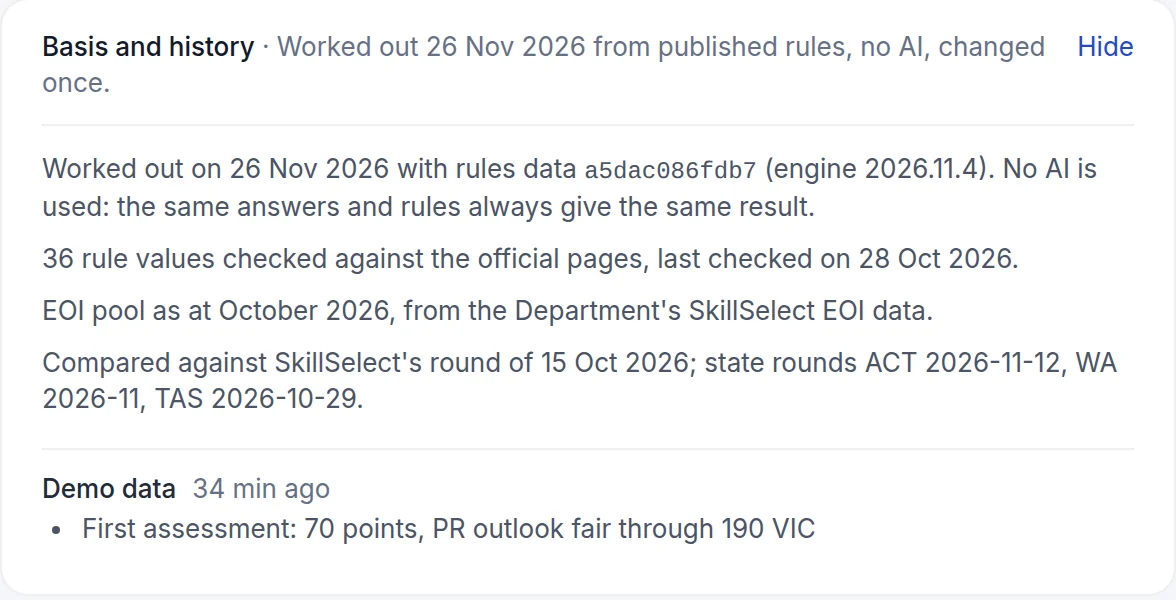 Basis and history: worked out from published rules, no AI; the rules version, values checked, the round and EOI month used.
It's there so you can answer "why did you tell me 80 points in March?" and show that the result came from the published rules on that day. Re-assessing happens every morning, so a record is kept only when the result really changes.
What each fact rests on
The case check labels every fact on the file by what it rests on, so a proven fact is never confused with a claim:
| Label | Meaning |
|---|---|
| Documented | A document backs it, applied by someone in the practice |
| On file | The practice's own records |
| Client stated | The client's answer, with no document yet |
| AI reading | Read from a document by AI and not yet checked |
| Rules engine | Worked out by Pathway's rules |
How the rules are kept current
about 105 official pages are captured every morning. When one changes, it's flagged, and a person at OneFifty reads it and decides whether a rule changed. A page captured is not a rule verified: nothing the monitor does on its own changes a rule, with one exception, round results that read cleanly, which are applied at once and marked as applied automatically. Rule changes verified by OneFifty are listed with the clients of yours each one touches, and shown on Today until you've read them. Until a re-check is done, assessments carry on with the last verified value and say how old it is. Every value, its source and the date it was checked are public on rules and sources.
What-ifs
Because the engine is fast and exact, it answers what-ifs: what if the client turns 33 before the invitation, gets Superior English, finishes a Professional Year, or a state nominates them? Each is a rerun with one fact changed. Ask Pathway AI and it reruns the engine for each scenario, so the points are exact. See the 485 holder whose visa ends in 59 days.
What it doesn't do
A rules engine is only as right as the facts it's given. It can't judge whether employment is closely related to an occupation, or whether evidence will satisfy a case officer: which jobs count is your decision, and once you've marked any, only those count. State chances are an indication, because most states rank candidates against each other and don't publish cut-offs. The advice is yours.
Bring one enquiry. See what Pathway sees.
A 30-minute demo on an enquiry from your practice, names removed: the assessment, its place in the queue, and when Pathway would bring it back.
Live on 1 December 2026. Every practice starts with a 30-day free trial.
OneFifty. Beyond the ordinary.